AI-Assisted Development Lifecycle

chevp-ai-framework

A structured, modular process framework that turns AI from a speed tool into a reliable, accountable development partner.
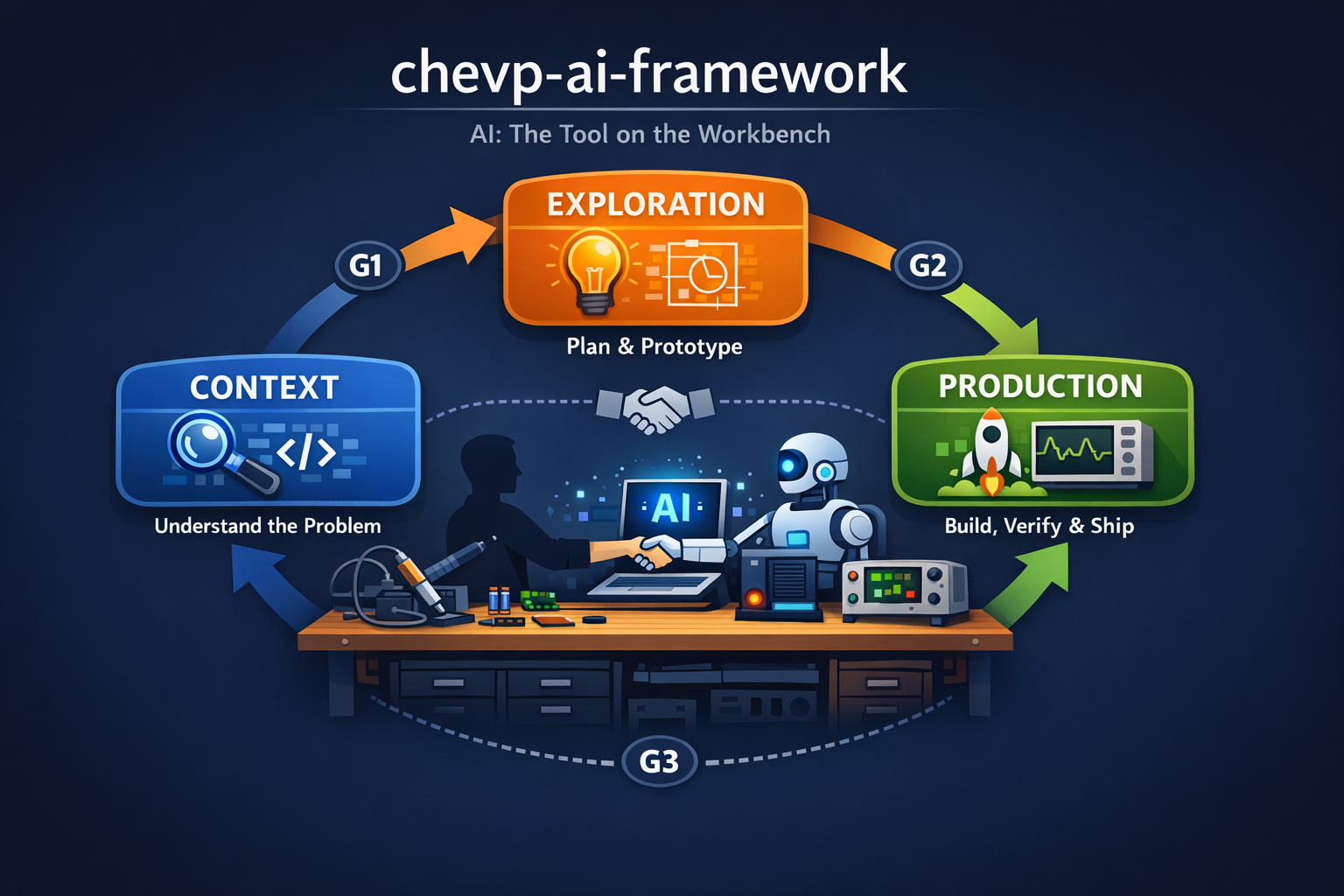

chevp-ai-framework overview
Patrice Chevillat

Patrice Chevillat

Software developer and creator of the chevp-ai-framework. Patrice designed the entire lifecycle concept, and documented the framework from the ground up.

Concept Architecture Documentation

The Problem

AI generates code faster than ever. But speed without structure creates new risks.

What goes wrong

  • Hallucinated APIs and invented functions
  • Inconsistent architectures across sessions
  • Code nobody understands or can maintain
  • Scope creep: "I also improved X while I was at it"
  • No human oversight or validation gates

The root cause

  • No enforced process between prompt and commit
  • AI works without sufficient context
  • Output is accepted without review
  • Responsibility is unclear
  • No separation of planning and building

"Vibe Coding is not progress — it's technical recklessness."

The Solution: 3 Sequential Steps

Every task follows this lifecycle. No step may be skipped.

1 G1

Context

Understand the problem, gather context, confirm scope with the human.

2 G2

Exploration

Create plan/spec, prototype where applicable, obtain human approval.

3 G3

Production

Build step-by-step, validate against spec and prototype, ship.

Quality Gates between each step ensure the human explicitly approves before progressing.

6 Cross-Cutting Roles

Each role operates within every step, ensuring complete coverage.

SDLC

Process governance, quality gates, step transitions, iteration rules.

AI-Plans

Plan/spec artifacts, acceptance criteria, scope management, execution tracking.

UX-Tooling

Prototypes, preview feedback loops, visual validation, prototype iteration.

DevOps

Build verification, commit workflow, CI/CD, delivery pipeline.

Software Architecture

ADRs, pattern enforcement, design decisions, dependency mapping.

Context Engineering

CLAUDE.md, context hierarchy, what AI must read, documentation maintenance.

The Lifecycle Matrix

3 Steps × 6 Roles — the complete governance framework.

Role Context Exploration Production
SDLCEnforce Context-firstSpec/prototype governanceImplementation rules
AI-PlansProblem formulationPlan/spec creationExecution tracking
UX-ToolingPrototype workflowVisual validation
DevOpsBuild, test, commit
Software ArchitectureCodebase analysisADR & trade-offsPattern enforcement
Context EngineeringContext hierarchyArtifact storageDoc maintenance
Step 1

Context — Understand Before Acting

Activities

  • Read existing code and documentation
  • Identify patterns and dependencies
  • Map affected modules and files
  • Surface and resolve ambiguities
  • Confirm scope with the human

Outputs

  • Clear problem description (1-2 sentences)
  • List of affected components
  • Open questions resolved
  • Architecture analysis

Quality Gate G1

  • Problem understood and described
  • Affected files identified
  • Existing patterns understood
  • Human has confirmed scope
Step 2

Exploration — Plan & Prototype

Spec Matrix

Feature developmentAlways
Architecture changeAlways + ADR
Complex bugfixAlways
Trivial change (<10 lines)Verbal OK

Prototype Workflow

  • AI creates prototype based on spec
  • Human reviews in preview
  • Human gives feedback, AI iterates
  • Human confirms: "This is the direction"
  • Prototype becomes reference for Production

Quality Gate G2

  • Plan/spec approved by human
  • Prototype confirmed (if applicable)
  • Risks and alternatives documented
Step 3

Production — Build, Verify, Ship

Implementation Rules

  • One step at a time — not everything at once
  • Build after each step — does it still compile?
  • Minimal changes — only what the plan specifies
  • No scope expansion — the plan is the plan
  • Validate before delivery — every criterion checked

Validation Methods

Build verificationAlways
Preview comparisonVisual / physical output
Spec comparisonAlways
TestsWhen test suite exists

Quality Gate G3

  • All acceptance criteria fulfilled
  • Build passes, no regressions
  • Human gives final approval

The Core Principle

"AI suggests, humans decide.
Ownership stays with the developer."

AI Does

Analyze, suggest, implement after approval, validate against spec.

AI Does Not Decide

Scope, priorities, architecture direction, when something is "done".

Human Controls

Every gate transition, final approval, commit, and push decisions.

Modular Composition

Composable layers instead of one monolithic framework.
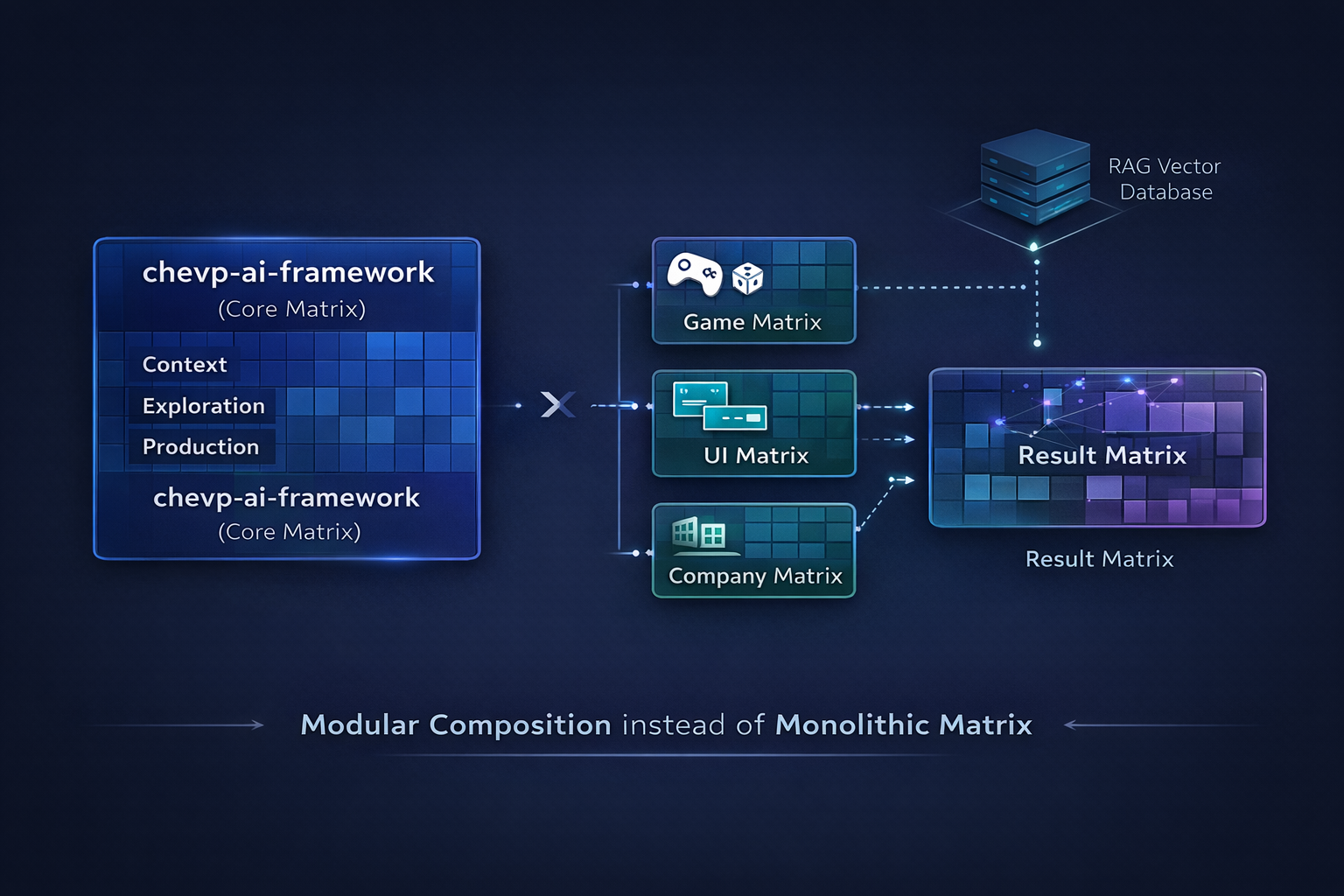
Core Matrix — Modular Framework Composition
Result = Core Framework ⊕ Domain Framework ⊕ External Knowledge (RAG)

Composition Layers

Independent layers that can be added, replaced, or evolved in isolation.

Core Matrix
C

Core Framework

Process, lifecycle, guardrails. Domain-agnostic. Rarely changes.

chevp-ai-framework

D

Domain Frameworks

Specialized rules, patterns, and constraints per field. Evolves with the domain.

e.g. Games, UI, Enterprise

R

External Knowledge

RAG-based vector databases, real-time or proprietary context. Dynamic.

Context injection at query time

Composable

Domains are interchangeable modules

Independent

Each layer evolves on its own

Selective

Load only what the project needs

Integration via CLAUDE.md

A single file controls AI behavior in every project.

Context Hierarchy

chevp-ai-framework/CLAUDE.md
  ↓ referenced by
<project>/CLAUDE.md
  ↓ supplemented by
<project>/context/guidelines/

A project can tighten framework rules but never loosen them.

Project Structure

<project-root>/
├── CLAUDE.md
├── context/
│   ├── architecture/
│   ├── adr/
│   ├── guidelines/
│   ├── plans/
│   │   └── finished/
│   └── specs/
└── src/

Anti-Patterns to Avoid

Common mistakes that undermine AI-assisted development.

"Build the complete feature" Step by step with feedback
Let AI work without context Provide CLAUDE.md + API reference
Accept output without preview Preview feedback loop
Change too much at once Small, reviewable steps
"I also refactored X while I was at it" Only implement the plan
Over-engineering / premature abstraction Minimal solution, 3 lines are OK

Templates & Artifacts

Ready-to-use templates for every stage of the lifecycle.

Plan Template

Goal, context, scope, steps, affected files, risks, acceptance criteria.

context/plans/EXP-NNN-*.md

Spec Template

Requirements (functional + non-functional), design, data model, interfaces.

context/specs/<name>/README.md

ADR Template

Status, context, decision, alternatives with trade-offs, consequences.

context/adr/ADR-NNN-*.md

Prototype Template

Reference spec, prototype form, goal, constraints, iteration log.

UX-Prototype-*.md

At a Glance

3

Sequential Steps

Context → Exploration → Production

6

Cross-Cutting Roles

SDLC, AI-Plans, UX, DevOps, Arch, Context

3

Quality Gates

Human approval at every transition

4

Templates provided

MIT

Open Source License

Domain-extensible

Getting Started

Integrate the framework into any project in minutes.

1

Copy CLAUDE.md template

Use templates/claude-md-template.md as your project's CLAUDE.md

2

Create context directory

mkdir -p context/{architecture,adr,guidelines,plans/finished,specs}

3

Reference the framework

Add the framework lifecycle reference to your project's CLAUDE.md

4

Start with Context

Every task begins with Step 1. No exceptions.

Structure Enables Speed

The framework slows down to speed up — less rework, shared understanding, clear responsibility.

github.com/chevp/chevp-ai-framework

Open Source · MIT License · Ready to integrate

chevp-ai-framework