psychology

chevp-ai-framework

Lifecycle Roles Domain Extension Quick Start slideshow Presentation

A structured lifecycle for
AI-assisted software development

Vibe Coding is not progress — it's technical recklessness.
AI writes code, but it doesn't take responsibility. This framework does.

MIT License · Generic · Reusable · Domain-agnostic

Lifecycle

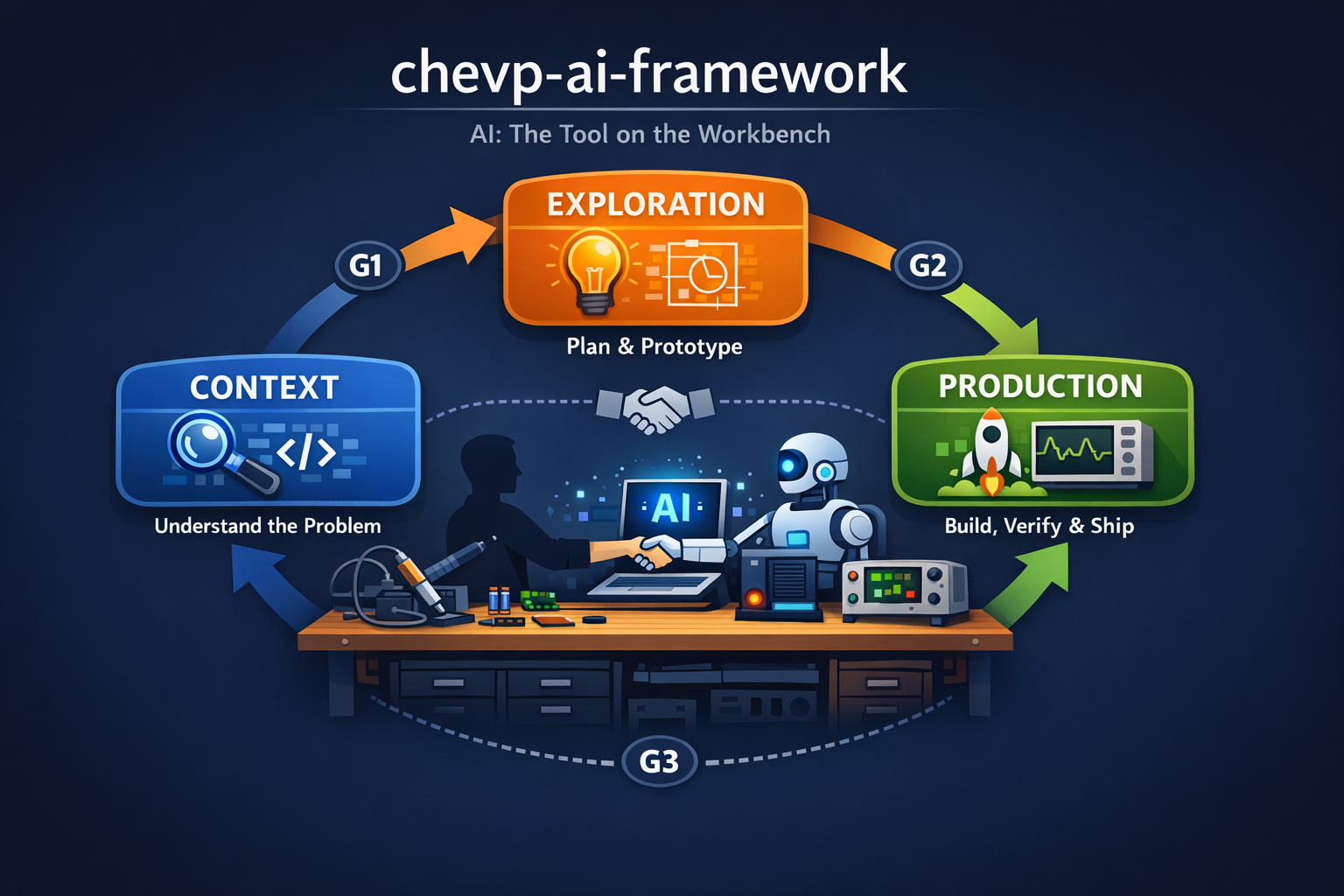
3 steps, 3 quality gates, human approval at every transition

chevp-ai-framework lifecycle
1

Context

Understand the problem, gather context, confirm scope

Output: Problem description, affected modules, confirmed scope

2

Exploration

Plan the solution, prototype, validate the approach

Output: Approved plan/spec, prototype, ADR

3

Production

Build, verify, ship

Output: Production code, passing tests, commit on main

Quality Gates

G1

Context → Exploration

Problem understood, modules identified, scope confirmed

G2

Exploration → Production

Plan/spec approved, prototype visually confirmed

G3

Production → Done

Acceptance criteria fulfilled, no regressions, human approved

Roles

Six cross-cutting roles operate within each step

settings

SDLC

Process governance, quality gates, step transitions

description

AI-Plans

Plan/spec artifacts, acceptance criteria, scope management

design_services

UX-Tooling

Prototypes, preview feedback loops, visual/physical validation

deployed_code

DevOps

Build verification, commit workflow, CI/CD

architecture

Software-Architecture

ADRs, pattern enforcement, design decisions

psychology

Context-Engineering

CLAUDE.md, context hierarchy, what AI must read

Domain Extension

Generic core, domain-specific layers, project-level frameworks

Domain AI Framework Architecture
foundation

chevp-ai-framework

The core lifecycle with Context, Exploration, and Production. Generic and reusable across all domains.

extension

domain-ai-framework

Domain-specific extension adding specialized rules, templates, and conventions (e.g. Game, UI, Data Pipelines).

rocket_launch

Project Frameworks

Concrete project frameworks (e.g. nuna-ai-framework) that inherit from the domain layer and produce final artifacts.

Principles

The rules that make AI-assisted development responsible

Prototype ≠ Production

Quickly generated code must be reviewed and understood

Context is mandatory

AI without context invents things

Incremental

Small steps with validation after each step

Human decides

AI suggests, the developer bears responsibility

Quick Start

Add this to your project's CLAUDE.md — that's it

1

Add this block to your project's CLAUDE.md

## STOP — Before Any Change

DO NOT create, edit, or delete any file before:
1. The chevp-ai-framework has been loaded:
   @url https://chevp.github.io/chevp-ai-framework/chevp-ai-framework.md
2. The current phase-step (Context / Exploration / Production)
   is confirmed with the human
2

Create the context directory structure

mkdir -p context/{architecture,adr,guidelines,plans/finished,specs}
3

Done

Claude loads the framework automatically via @url and enforces the lifecycle. No submodule, no fork, no local copy needed.

Repository Structure

Clear separation of lifecycle steps, templates, and guidelines

01-context/       # Step 1 — Understand the problem
02-exploration/   # Step 2 — Plan and prototype
03-production/    # Step 3 — Build, verify, ship
templates/        # Plan, spec, ADR, CLAUDE.md, prototype templates
guidelines/       # Cross-cutting quality rules
integration/      # Integration into existing projects