Full Stack Web Application Ecosystem Tutorial
Overview
This tutorial demonstrates building a complete software ecosystem from frontend to backend, including databases, caching, monitoring, and deployment. We'll create a modern e-commerce platform that showcases how different technologies work together in production.
System Architecture Overview
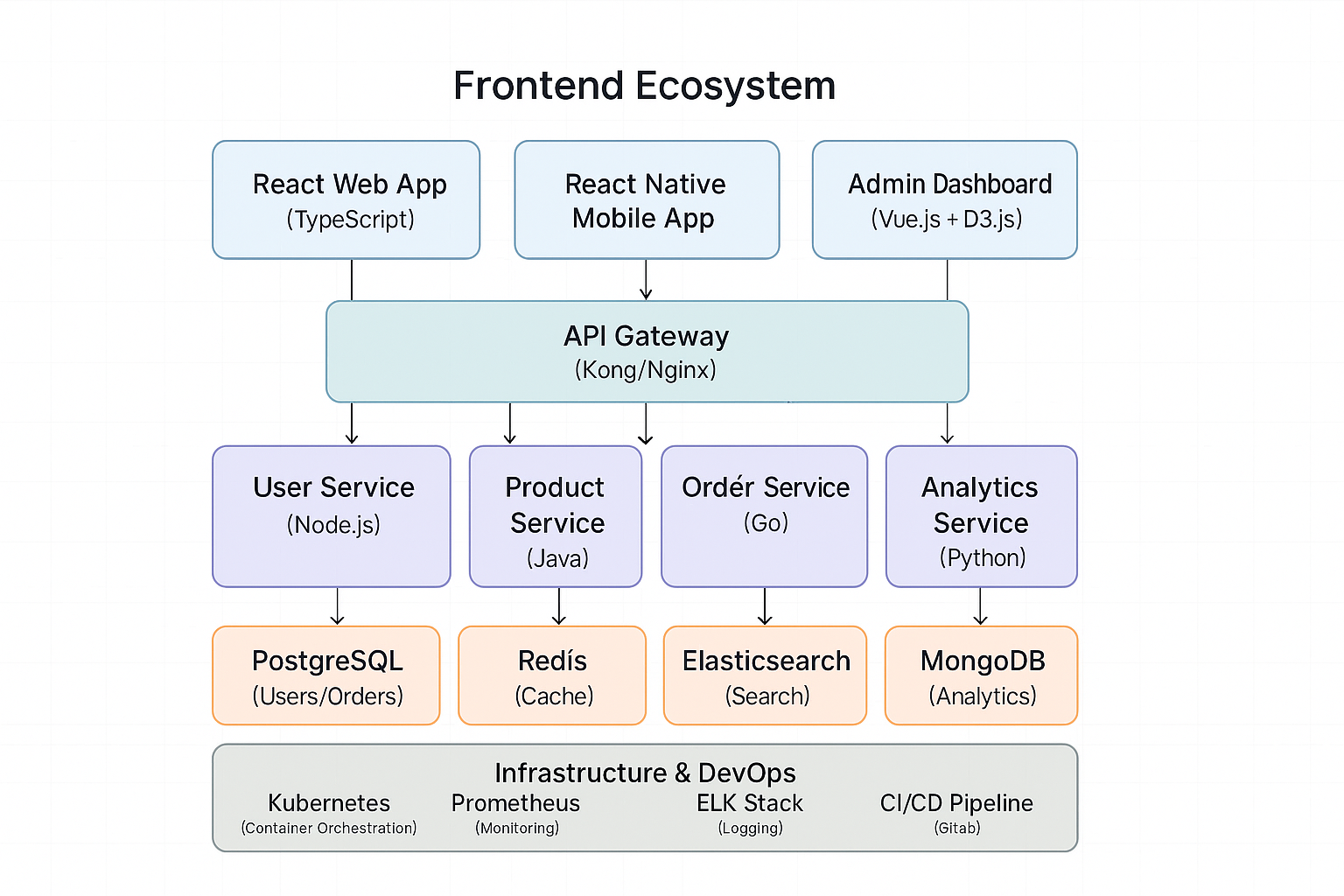
Frontend Ecosystem
React Web Application
Project Structure:
frontend-web/
├── src/
│   ├── components/
│   │   ├── common/
│   │   ├── product/
│   │   ├── user/
│   │   └── checkout/
│   ├── hooks/
│   ├── services/
│   ├── store/
│   ├── types/
│   └── utils/
├── public/
├── tests/
└── docs/
Core Application Setup:
// src/types/index.ts
export interface User {
  id: string;
  email: string;
  name: string;
  role: 'customer' | 'admin';
  preferences: UserPreferences;
}

export interface Product {
  id: string;
  name: string;
  description: string;
  price: number;
  category: string;
  inventory: number;
  images: string[];
  metadata: Record<string, any>;
}

export interface Order {
  id: string;
  userId: string;
  products: OrderItem[];
  status: 'pending' | 'processing' | 'shipped' | 'delivered' | 'cancelled';
  total: number;
  createdAt: Date;
  updatedAt: Date;
}

export interface OrderItem {
  productId: string;
  quantity: number;
  price: number;
}
// src/services/api.ts
import axios, { AxiosInstance, AxiosRequestConfig } from 'axios';

class ApiService {
  private client: AxiosInstance;

  constructor(baseURL: string) {
    this.client = axios.create({
      baseURL,
      timeout: 10000,
      headers: {
        'Content-Type': 'application/json',
      },
    });

    this.setupInterceptors();
  }

  private setupInterceptors() {
    // Request interceptor for auth tokens
    this.client.interceptors.request.use(
      (config) => {
        const token = localStorage.getItem('authToken');
        if (token) {
          config.headers.Authorization = `Bearer ${token}`;
        }
        return config;
      },
      (error) => Promise.reject(error)
    );

    // Response interceptor for error handling
    this.client.interceptors.response.use(
      (response) => response,
      (error) => {
        if (error.response?.status === 401) {
          localStorage.removeItem('authToken');
          window.location.href = '/login';
        }
        return Promise.reject(error);
      }
    );
  }

  async get<T>(url: string, config?: AxiosRequestConfig): Promise<T> {
    const response = await this.client.get<T>(url, config);
    return response.data;
  }

  async post<T>(url: string, data?: any, config?: AxiosRequestConfig): Promise<T> {
    const response = await this.client.post<T>(url, data, config);
    return response.data;
  }

  async put<T>(url: string, data?: any, config?: AxiosRequestConfig): Promise<T> {
    const response = await this.client.put<T>(url, data, config);
    return response.data;
  }

  async delete<T>(url: string, config?: AxiosRequestConfig): Promise<T> {
    const response = await this.client.delete<T>(url, config);
    return response.data;
  }
}

export const apiService = new ApiService(process.env.REACT_APP_API_URL || 'http://localhost:8080');
// src/store/userStore.ts
import { create } from 'zustand';
import { persist } from 'zustand/middleware';
import { User } from '../types';
import { apiService } from '../services/api';

interface UserState {
  user: User | null;
  isLoading: boolean;
  error: string | null;
  login: (email: string, password: string) => Promise<void>;
  logout: () => void;
  updateProfile: (updates: Partial<User>) => Promise<void>;
}

export const useUserStore = create<UserState>()(
  persist(
    (set, get) => ({
      user: null,
      isLoading: false,
      error: null,

      login: async (email: string, password: string) => {
        set({ isLoading: true, error: null });
        try {
          const response = await apiService.post<{
            user: User;
            token: string;
          }>('/auth/login', { email, password });

          localStorage.setItem('authToken', response.token);
          set({ user: response.user, isLoading: false });
        } catch (error: any) {
          set({
            error: error.response?.data?.message || 'Login failed',
            isLoading: false,
          });
          throw error;
        }
      },

      logout: () => {
        localStorage.removeItem('authToken');
        set({ user: null, error: null });
      },

      updateProfile: async (updates: Partial<User>) => {
        const { user } = get();
        if (!user) throw new Error('No user logged in');

        set({ isLoading: true, error: null });
        try {
          const updatedUser = await apiService.put<User>(`/users/${user.id}`, updates);
          set({ user: updatedUser, isLoading: false });
        } catch (error: any) {
          set({
            error: error.response?.data?.message || 'Update failed',
            isLoading: false,
          });
          throw error;
        }
      },
    }),
    {
      name: 'user-storage',
      partialize: (state) => ({ user: state.user }),
    }
  )
);
// src/components/product/ProductList.tsx
import React, { useEffect, useState } from 'react';
import { Product } from '../../types';
import { apiService } from '../../services/api';
import { ProductCard } from './ProductCard';
import { SearchBar } from '../common/SearchBar';
import { Pagination } from '../common/Pagination';

interface ProductListProps {
  category?: string;
}

export const ProductList: React.FC<ProductListProps> = ({ category }) => {
  const [products, setProducts] = useState<Product[]>([]);
  const [loading, setLoading] = useState(true);
  const [error, setError] = useState<string | null>(null);
  const [page, setPage] = useState(1);
  const [totalPages, setTotalPages] = useState(0);
  const [searchQuery, setSearchQuery] = useState('');

  useEffect(() => {
    fetchProducts();
  }, [page, category, searchQuery]);

  const fetchProducts = async () => {
    setLoading(true);
    try {
      const params = new URLSearchParams({
        page: page.toString(),
        limit: '12',
        ...(category && { category }),
        ...(searchQuery && { search: searchQuery }),
      });

      const response = await apiService.get<{
        products: Product[];
        totalPages: number;
      }>(`/products?${params}`);

      setProducts(response.products);
      setTotalPages(response.totalPages);
    } catch (err: any) {
      setError(err.message);
    } finally {
      setLoading(false);
    }
  };

  const handleSearch = (query: string) => {
    setSearchQuery(query);
    setPage(1);
  };

  if (loading) return <div className="loading">Loading products...</div>;
  if (error) return <div className="error">Error: {error}</div>;

  return (
    <div className="product-list">
      <SearchBar onSearch={handleSearch} placeholder="Search products..." />

      <div className="product-grid">
        {products.map((product) => (
          <ProductCard key={product.id} product={product} />
        ))}
      </div>

      <Pagination
        currentPage={page}
        totalPages={totalPages}
        onPageChange={setPage}
      />
    </div>
  );
};
React Native Mobile Application
// mobile-app/src/services/ApiService.ts
import axios, { AxiosInstance } from 'axios';
import AsyncStorage from '@react-native-async-storage/async-storage';
import NetInfo from '@react-native-netinfo/netinfo';

class MobileApiService {
  private client: AxiosInstance;
  private offlineQueue: any[] = [];

  constructor() {
    this.client = axios.create({
      baseURL: 'https://api.yourapp.com',
      timeout: 15000,
    });

    this.setupInterceptors();
    this.setupOfflineHandling();
  }

  private setupInterceptors() {
    this.client.interceptors.request.use(async (config) => {
      const token = await AsyncStorage.getItem('authToken');
      if (token) {
        config.headers.Authorization = `Bearer ${token}`;
      }
      return config;
    });

    this.client.interceptors.response.use(
      (response) => response,
      async (error) => {
        if (error.response?.status === 401) {
          await AsyncStorage.removeItem('authToken');
          // Navigate to login screen
        }
        return Promise.reject(error);
      }
    );
  }

  private setupOfflineHandling() {
    NetInfo.addEventListener((state) => {
      if (state.isConnected && this.offlineQueue.length > 0) {
        this.processOfflineQueue();
      }
    });
  }

  private async processOfflineQueue() {
    const queue = [...this.offlineQueue];
    this.offlineQueue = [];

    for (const request of queue) {
      try {
        await this.client(request);
      } catch (error) {
        // Re-queue failed requests
        this.offlineQueue.push(request);
      }
    }
  }

  async get<T>(url: string): Promise<T> {
    try {
      const response = await this.client.get<T>(url);
      return response.data;
    } catch (error) {
      const cachedData = await this.getCachedData(url);
      if (cachedData) return cachedData;
      throw error;
    }
  }

  private async getCachedData(url: string) {
    try {
      const cached = await AsyncStorage.getItem(`cache_${url}`);
      return cached ? JSON.parse(cached) : null;
    } catch {
      return null;
    }
  }
}

export const mobileApiService = new MobileApiService();
// mobile-app/src/components/ProductCard.tsx
import React from 'react';
import { View, Text, Image, TouchableOpacity, StyleSheet } from 'react-native';
import { Product } from '../types';

interface ProductCardProps {
  product: Product;
  onPress: (product: Product) => void;
}

export const ProductCard: React.FC<ProductCardProps> = ({ product, onPress }) => {
  return (
    <TouchableOpacity
      style={styles.card}
      onPress={() => onPress(product)}
      activeOpacity={0.7}
    >
      <Image
        source={{ uri: product.images[0] }}
        style={styles.image}
        resizeMode="cover"
      />
      <View style={styles.content}>
        <Text style={styles.name} numberOfLines={2}>
          {product.name}
        </Text>
        <Text style={styles.price}>${product.price}</Text>
        <Text style={styles.category}>{product.category}</Text>
      </View>
    </TouchableOpacity>
  );
};

const styles = StyleSheet.create({
  card: {
    backgroundColor: 'white',
    borderRadius: 8,
    shadowColor: '#000',
    shadowOffset: { width: 0, height: 2 },
    shadowOpacity: 0.1,
    shadowRadius: 4,
    elevation: 3,
    margin: 8,
  },
  image: {
    width: '100%',
    height: 200,
    borderTopLeftRadius: 8,
    borderTopRightRadius: 8,
  },
  content: {
    padding: 12,
  },
  name: {
    fontSize: 16,
    fontWeight: '600',
    marginBottom: 4,
  },
  price: {
    fontSize: 18,
    fontWeight: 'bold',
    color: '#007AFF',
    marginBottom: 4,
  },
  category: {
    fontSize: 12,
    color: '#666',
  },
});
Backend Microservices Ecosystem
User Service (Node.js + TypeScript)
// user-service/src/models/User.ts
import { Entity, PrimaryGeneratedColumn, Column, CreateDateColumn, UpdateDateColumn } from 'typeorm';
import { IsEmail, IsNotEmpty, MinLength } from 'class-validator';
import bcrypt from 'bcrypt';

@Entity('users')
export class User {
  @PrimaryGeneratedColumn('uuid')
  id: string;

  @Column({ unique: true })
  @IsEmail()
  email: string;

  @Column()
  @IsNotEmpty()
  @MinLength(2)
  name: string;

  @Column()
  @MinLength(8)
  password: string;

  @Column({ default: 'customer' })
  role: 'customer' | 'admin';

  @Column('json', { nullable: true })
  preferences: Record<string, any>;

  @CreateDateColumn()
  createdAt: Date;

  @UpdateDateColumn()
  updatedAt: Date;

  async hashPassword(): Promise<void> {
    this.password = await bcrypt.hash(this.password, 12);
  }

  async comparePassword(candidatePassword: string): Promise<boolean> {
    return bcrypt.compare(candidatePassword, this.password);
  }

  toJSON() {
    const { password, ...userWithoutPassword } = this;
    return userWithoutPassword;
  }
}
// user-service/src/services/UserService.ts
import { Repository } from 'typeorm';
import { User } from '../models/User';
import { AppDataSource } from '../config/database';
import { EventEmitter } from '../utils/EventEmitter';
import { CacheService } from './CacheService';
import jwt from 'jsonwebtoken';

export class UserService {
  private userRepository: Repository<User>;
  private cacheService: CacheService;
  private eventEmitter: EventEmitter;

  constructor() {
    this.userRepository = AppDataSource.getRepository(User);
    this.cacheService = new CacheService();
    this.eventEmitter = new EventEmitter();
  }

  async createUser(userData: Partial<User>): Promise<User> {
    const user = this.userRepository.create(userData);
    await user.hashPassword();

    const savedUser = await this.userRepository.save(user);

    // Cache user data
    await this.cacheService.set(`user:${savedUser.id}`, savedUser, 3600);

    // Emit user created event
    this.eventEmitter.emit('user.created', {
      userId: savedUser.id,
      email: savedUser.email,
      timestamp: new Date()
    });

    return savedUser;
  }

  async getUserById(id: string): Promise<User | null> {
    // Try cache first
    const cachedUser = await this.cacheService.get(`user:${id}`);
    if (cachedUser) {
      return cachedUser as User;
    }

    const user = await this.userRepository.findOne({ where: { id } });

    if (user) {
      await this.cacheService.set(`user:${id}`, user, 3600);
    }

    return user;
  }

  async authenticateUser(email: string, password: string): Promise<{ user: User; token: string } | null> {
    const user = await this.userRepository.findOne({ where: { email } });

    if (!user || !(await user.comparePassword(password))) {
      return null;
    }

    const token = jwt.sign(
      { userId: user.id, email: user.email, role: user.role },
      process.env.JWT_SECRET!,
      { expiresIn: '24h' }
    );

    // Update last login
    await this.userRepository.update(user.id, { updatedAt: new Date() });

    // Emit login event
    this.eventEmitter.emit('user.login', {
      userId: user.id,
      timestamp: new Date()
    });

    return { user, token };
  }

  async updateUser(id: string, updates: Partial<User>): Promise<User | null> {
    await this.userRepository.update(id, updates);

    // Invalidate cache
    await this.cacheService.delete(`user:${id}`);

    const updatedUser = await this.getUserById(id);

    if (updatedUser) {
      this.eventEmitter.emit('user.updated', {
        userId: id,
        changes: updates,
        timestamp: new Date()
      });
    }

    return updatedUser;
  }

  async getUsersByRole(role: string): Promise<User[]> {
    const cacheKey = `users:role:${role}`;
    const cached = await this.cacheService.get(cacheKey);

    if (cached) {
      return cached as User[];
    }

    const users = await this.userRepository.find({ where: { role: role as any } });
    await this.cacheService.set(cacheKey, users, 1800);

    return users;
  }
}
Product Service (Java Spring Boot)
// product-service/src/main/java/com/ecommerce/product/entity/Product.java
package com.ecommerce.product.entity;

import jakarta.persistence.*;
import jakarta.validation.constraints.*;
import lombok.Data;
import lombok.NoArgsConstructor;
import lombok.AllArgsConstructor;
import org.springframework.data.annotation.CreatedDate;
import org.springframework.data.annotation.LastModifiedDate;
import org.springframework.data.jpa.domain.support.AuditingEntityListener;

import java.math.BigDecimal;
import java.time.LocalDateTime;
import java.util.List;
import java.util.Map;

@Entity
@Table(name = "products")
@EntityListeners(AuditingEntityListener.class)
@Data
@NoArgsConstructor
@AllArgsConstructor
public class Product {

    @Id
    @GeneratedValue(strategy = GenerationType.UUID)
    private String id;

    @NotBlank(message = "Product name is required")
    @Size(min = 2, max = 100, message = "Product name must be between 2 and 100 characters")
    @Column(nullable = false, length = 100)
    private String name;

    @Size(max = 1000, message = "Description cannot exceed 1000 characters")
    @Column(length = 1000)
    private String description;

    @NotNull(message = "Price is required")
    @DecimalMin(value = "0.0", inclusive = false, message = "Price must be greater than 0")
    @Column(nullable = false, precision = 10, scale = 2)
    private BigDecimal price;

    @NotBlank(message = "Category is required")
    @Column(nullable = false, length = 50)
    private String category;

    @Min(value = 0, message = "Inventory cannot be negative")
    @Column(nullable = false)
    private Integer inventory;

    @ElementCollection
    @CollectionTable(name = "product_images", joinColumns = @JoinColumn(name = "product_id"))
    @Column(name = "image_url")
    private List<String> images;

    @ElementCollection
    @CollectionTable(name = "product_metadata", joinColumns = @JoinColumn(name = "product_id"))
    @MapKeyColumn(name = "metadata_key")
    @Column(name = "metadata_value")
    private Map<String, String> metadata;

    @Column(nullable = false)
    private Boolean active = true;

    @CreatedDate
    @Column(nullable = false, updatable = false)
    private LocalDateTime createdAt;

    @LastModifiedDate
    @Column(nullable = false)
    private LocalDateTime updatedAt;

    // Custom methods
    public boolean isInStock() {
        return inventory > 0;
    }

    public void decreaseInventory(int quantity) {
        if (inventory < quantity) {
            throw new IllegalArgumentException("Insufficient inventory");
        }
        inventory -= quantity;
    }

    public void increaseInventory(int quantity) {
        inventory += quantity;
    }
}
// product-service/src/main/java/com/ecommerce/product/service/ProductService.java
package com.ecommerce.product.service;

import com.ecommerce.product.entity.Product;
import com.ecommerce.product.repository.ProductRepository;
import com.ecommerce.product.dto.ProductDTO;
import com.ecommerce.product.dto.ProductSearchCriteria;
import com.ecommerce.product.exception.ProductNotFoundException;
import com.ecommerce.product.mapper.ProductMapper;
import lombok.RequiredArgsConstructor;
import lombok.extern.slf4j.Slf4j;
import org.springframework.cache.annotation.CacheEvict;
import org.springframework.cache.annotation.Cacheable;
import org.springframework.data.domain.Page;
import org.springframework.data.domain.Pageable;
import org.springframework.stereotype.Service;
import org.springframework.transaction.annotation.Transactional;

import java.util.List;

@Service
@RequiredArgsConstructor
@Slf4j
@Transactional
public class ProductService {

    private final ProductRepository productRepository;
    private final ProductMapper productMapper;
    private final ElasticsearchService elasticsearchService;
    private final EventPublisher eventPublisher;
    private final InventoryService inventoryService;

    @Transactional(readOnly = true)
    @Cacheable(value = "products", key = "#id")
    public ProductDTO getProductById(String id) {
        Product product = productRepository.findById(id)
                .orElseThrow(() -> new ProductNotFoundException("Product not found with id: " + id));

        // Log product view for analytics
        eventPublisher.publishEvent("product.viewed", Map.of(
            "productId", id,
            "timestamp", System.currentTimeMillis()
        ));

        return productMapper.toDTO(product);
    }

    @Transactional(readOnly = true)
    public Page<ProductDTO> searchProducts(ProductSearchCriteria criteria, Pageable pageable) {
        if (criteria.hasSearchQuery()) {
            // Use Elasticsearch for complex search
            return elasticsearchService.searchProducts(criteria, pageable);
        }

        // Use database for simple queries
        Page<Product> products = productRepository.findByCriteria(criteria, pageable);
        return products.map(productMapper::toDTO);
    }

    public ProductDTO createProduct(ProductDTO productDTO) {
        Product product = productMapper.toEntity(productDTO);
        product.setActive(true);

        Product savedProduct = productRepository.save(product);

        // Index in Elasticsearch
        elasticsearchService.indexProduct(savedProduct);

        // Initialize inventory
        inventoryService.initializeInventory(savedProduct.getId(), savedProduct.getInventory());

        // Publish product created event
        eventPublisher.publishEvent("product.created", Map.of(
            "productId", savedProduct.getId(),
            "category", savedProduct.getCategory(),
            "price", savedProduct.getPrice(),
            "timestamp", System.currentTimeMillis()
        ));

        log.info("Product created successfully: {}", savedProduct.getId());
        return productMapper.toDTO(savedProduct);
    }

    @CacheEvict(value = "products", key = "#id")
    public ProductDTO updateProduct(String id, ProductDTO productDTO) {
        Product existingProduct = productRepository.findById(id)
                .orElseThrow(() -> new ProductNotFoundException("Product not found with id: " + id));

        // Map updates
        productMapper.updateEntityFromDTO(productDTO, existingProduct);

        Product updatedProduct = productRepository.save(existingProduct);

        // Update Elasticsearch index
        elasticsearchService.updateProduct(updatedProduct);

        // Update inventory if changed
        if (!existingProduct.getInventory().equals(updatedProduct.getInventory())) {
            inventoryService.updateInventory(id, updatedProduct.getInventory());
        }

        // Publish product updated event
        eventPublisher.publishEvent("product.updated", Map.of(
            "productId", id,
            "changes", productMapper.getChanges(existingProduct, updatedProduct),
            "timestamp", System.currentTimeMillis()
        ));

        return productMapper.toDTO(updatedProduct);
    }

    @CacheEvict(value = "products", key = "#id")
    public void deleteProduct(String id) {
        Product product = productRepository.findById(id)
                .orElseThrow(() -> new ProductNotFoundException("Product not found with id: " + id));

        product.setActive(false);
        productRepository.save(product);

        // Remove from Elasticsearch
        elasticsearchService.deleteProduct(id);

        // Publish product deleted event
        eventPublisher.publishEvent("product.deleted", Map.of(
            "productId", id,
            "timestamp", System.currentTimeMillis()
        ));

        log.info("Product deleted successfully: {}", id);
    }

    @Transactional(readOnly = true)
    public List<ProductDTO> getProductsByCategory(String category) {
        List<Product> products = productRepository.findByCategory(category);
        return products.stream()
                .map(productMapper::toDTO)
                .toList();
    }

    public boolean reserveInventory(String productId, int quantity) {
        Product product = productRepository.findById(productId)
                .orElseThrow(() -> new ProductNotFoundException("Product not found with id: " + productId));

        if (!product.isInStock() || product.getInventory() < quantity) {
            return false;
        }

        product.decreaseInventory(quantity);
        productRepository.save(product);

        // Update inventory service
        inventoryService.reserveInventory(productId, quantity);

        // Publish inventory reserved event
        eventPublisher.publishEvent("inventory.reserved", Map.of(
            "productId", productId,
            "quantity", quantity,
            "remainingInventory", product.getInventory(),
            "timestamp", System.currentTimeMillis()
        ));

        return true;
    }
}
Order Service (Go + Gin)
// order-service/internal/models/order.go
package models

import (
    "time"
    "github.com/google/uuid"
    "gorm.io/gorm"
)

type OrderStatus string

const (
    OrderStatusPending    OrderStatus = "pending"
    OrderStatusProcessing OrderStatus = "processing"
    OrderStatusShipped    OrderStatus = "shipped"
    OrderStatusDelivered  OrderStatus = "delivered"
    OrderStatusCancelled  OrderStatus = "cancelled"
)

type Order struct {
    ID        string      `json:"id" gorm:"primaryKey;type:uuid"`
    UserID    string      `json:"userId" gorm:"not null;type:uuid"`
    Status    OrderStatus `json:"status" gorm:"not null;default:'pending'"`
    Total     float64     `json:"total" gorm:"not null"`
    Currency  string      `json:"currency" gorm:"not null;default:'USD'"`
    Items     []OrderItem `json:"items" gorm:"foreignKey:OrderID"`
    Address   Address     `json:"address" gorm:"embedded"`
    CreatedAt time.Time   `json:"createdAt"`
    UpdatedAt time.Time   `json:"updatedAt"`
}

type OrderItem struct {
    ID        string  `json:"id" gorm:"primaryKey;type:uuid"`
    OrderID   string  `json:"orderId" gorm:"not null;type:uuid"`
    ProductID string  `json:"productId" gorm:"not null;type:uuid"`
    Quantity  int     `json:"quantity" gorm:"not null"`
    Price     float64 `json:"price" gorm:"not null"`
}

type Address struct {
    Street     string `json:"street"`
    City       string `json:"city"`
    State      string `json:"state"`
    PostalCode string `json:"postalCode"`
    Country    string `json:"country"`
}

func (o *Order) BeforeCreate(tx *gorm.DB) error {
    if o.ID == "" {
        o.ID = uuid.New().String()
    }
    return nil
}

func (oi *OrderItem) BeforeCreate(tx *gorm.DB) error {
    if oi.ID == "" {
        oi.ID = uuid.New().String()
    }
    return nil
}
// order-service/internal/services/order_service.go
package services

import (
    "context"
    "encoding/json"
    "fmt"
    "log"
    "time"

    "github.com/go-redis/redis/v8"
    "gorm.io/gorm"

    "order-service/internal/models"
    "order-service/internal/clients"
    "order-service/internal/events"
)

type OrderService struct {
    db            *gorm.DB
    redis         *redis.Client
    productClient *clients.ProductClient
    userClient    *clients.UserClient
    eventEmitter  *events.EventEmitter
}

func NewOrderService(db *gorm.DB, redis *redis.Client) *OrderService {
    return &OrderService{
        db:            db,
        redis:         redis,
        productClient: clients.NewProductClient(),
        userClient:    clients.NewUserClient(),
        eventEmitter:  events.NewEventEmitter(),
    }
}

func (s *OrderService) CreateOrder(ctx context.Context, userID string, items []models.OrderItem, address models.Address) (*models.Order, error) {
    // Start transaction
    tx := s.db.Begin()
    defer func() {
        if r := recover(); r != nil {
            tx.Rollback()
        }
    }()

    // Validate user exists
    user, err := s.userClient.GetUser(ctx, userID)
    if err != nil {
        tx.Rollback()
        return nil, fmt.Errorf("invalid user: %w", err)
    }

    // Validate and reserve inventory for each item
    var total float64
    var validatedItems []models.OrderItem

    for _, item := range items {
        product, err := s.productClient.GetProduct(ctx, item.ProductID)
        if err != nil {
            tx.Rollback()
            return nil, fmt.Errorf("invalid product %s: %w", item.ProductID, err)
        }

        // Check inventory
        available, err := s.productClient.CheckInventory(ctx, item.ProductID, item.Quantity)
        if err != nil || !available {
            tx.Rollback()
            return nil, fmt.Errorf("insufficient inventory for product %s", item.ProductID)
        }

        // Reserve inventory
        if err := s.productClient.ReserveInventory(ctx, item.ProductID, item.Quantity); err != nil {
            tx.Rollback()
            return nil, fmt.Errorf("failed to reserve inventory: %w", err)
        }

        item.Price = product.Price
        total += product.Price * float64(item.Quantity)
        validatedItems = append(validatedItems, item)
    }

    // Create order
    order := &models.Order{
        UserID:  userID,
        Status:  models.OrderStatusPending,
        Total:   total,
        Address: address,
        Items:   validatedItems,
    }

    if err := tx.Create(order).Error; err != nil {
        tx.Rollback()
        return nil, fmt.Errorf("failed to create order: %w", err)
    }

    // Commit transaction
    if err := tx.Commit().Error; err != nil {
        return nil, fmt.Errorf("failed to commit transaction: %w", err)
    }

    // Cache order
    orderJSON, _ := json.Marshal(order)
    s.redis.Set(ctx, fmt.Sprintf("order:%s", order.ID), orderJSON, time.Hour)

    // Emit order created event
    s.eventEmitter.EmitEvent("order.created", map[string]interface{}{
        "orderId":   order.ID,
        "userId":    order.UserID,
        "total":     order.Total,
        "itemCount": len(order.Items),
        "timestamp": time.Now().Unix(),
    })

    // Send confirmation email asynchronously
    go s.sendOrderConfirmation(order, user.Email)

    log.Printf("Order created successfully: %s", order.ID)
    return order, nil
}

func (s *OrderService) GetOrder(ctx context.Context, orderID string) (*models.Order, error) {
    // Try cache first
    cached, err := s.redis.Get(ctx, fmt.Sprintf("order:%s", orderID)).Result()
    if err == nil {
        var order models.Order
        if json.Unmarshal([]byte(cached), &order) == nil {
            return &order, nil
        }
    }

    // Fallback to database
    var order models.Order
    if err := s.db.Preload("Items").First(&order, "id = ?", orderID).Error; err != nil {
        return nil, fmt.Errorf("order not found: %w", err)
    }

    // Update cache
    orderJSON, _ := json.Marshal(order)
    s.redis.Set(ctx, fmt.Sprintf("order:%s", orderID), orderJSON, time.Hour)

    return &order, nil
}

func (s *OrderService) UpdateOrderStatus(ctx context.Context, orderID string, status models.OrderStatus) error {
    var order models.Order
    if err := s.db.First(&order, "id = ?", orderID).Error; err != nil {
        return fmt.Errorf("order not found: %w", err)
    }

    oldStatus := order.Status
    order.Status = status

    if err := s.db.Save(&order).Error; err != nil {
        return fmt.Errorf("failed to update order status: %w", err)
    }

    // Invalidate cache
    s.redis.Del(ctx, fmt.Sprintf("order:%s", orderID))

    // Emit status change event
    s.eventEmitter.EmitEvent("order.status_changed", map[string]interface{}{
        "orderId":   orderID,
        "oldStatus": oldStatus,
        "newStatus": status,
        "timestamp": time.Now().Unix(),
    })

    // Handle status-specific logic
    switch status {
    case models.OrderStatusProcessing:
        go s.processPayment(ctx, &order)
    case models.OrderStatusShipped:
        go s.sendShippingNotification(&order)
    case models.OrderStatusCancelled:
        go s.restoreInventory(ctx, &order)
    }

    return nil
}

func (s *OrderService) GetOrdersByUser(ctx context.Context, userID string, limit, offset int) ([]models.Order, error) {
    var orders []models.Order

    if err := s.db.Preload("Items").Where("user_id = ?", userID).
        Limit(limit).Offset(offset).
        Order("created_at DESC").
        Find(&orders).Error; err != nil {
        return nil, fmt.Errorf("failed to get user orders: %w", err)
    }

    return orders, nil
}

func (s *OrderService) sendOrderConfirmation(order *models.Order, userEmail string) {
    // Implementation for sending order confirmation email
    log.Printf("Sending order confirmation to %s for order %s", userEmail, order.ID)
    // This would integrate with an email service
}

func (s *OrderService) processPayment(ctx context.Context, order *models.Order) {
    // Implementation for payment processing
    log.Printf("Processing payment for order %s", order.ID)
    // This would integrate with a payment service
}

func (s *OrderService) sendShippingNotification(order *models.Order) {
    // Implementation for shipping notifications
    log.Printf("Sending shipping notification for order %s", order.ID)
}

func (s *OrderService) restoreInventory(ctx context.Context, order *models.Order) {
    // Restore inventory for cancelled orders
    for _, item := range order.Items {
        if err := s.productClient.RestoreInventory(ctx, item.ProductID, item.Quantity); err != nil {
            log.Printf("Failed to restore inventory for product %s: %v", item.ProductID, err)
        }
    }
}
Analytics Service (Python + FastAPI)
# analytics-service/app/models.py
from sqlalchemy import Column, String, Integer, Float, DateTime, JSON, Boolean
from sqlalchemy.dialects.postgresql import UUID
from sqlalchemy.ext.declarative import declarative_base
from sqlalchemy.sql import func
from datetime import datetime
import uuid

Base = declarative_base()

class Event(Base):
    __tablename__ = "events"

    id = Column(UUID(as_uuid=True), primary_key=True, default=uuid.uuid4)
    event_type = Column(String(100), nullable=False, index=True)
    user_id = Column(String(100), index=True)
    product_id = Column(String(100), index=True)
    session_id = Column(String(100), index=True)
    properties = Column(JSON)
    timestamp = Column(DateTime(timezone=True), server_default=func.now(), index=True)
    processed = Column(Boolean, default=False, index=True)

class UserBehavior(Base):
    __tablename__ = "user_behaviors"

    id = Column(UUID(as_uuid=True), primary_key=True, default=uuid.uuid4)
    user_id = Column(String(100), nullable=False, index=True)
    session_id = Column(String(100), nullable=False, index=True)
    page_views = Column(Integer, default=0)
    time_spent = Column(Float, default=0.0)
    bounce_rate = Column(Float)
    conversion_events = Column(JSON)
    created_at = Column(DateTime(timezone=True), server_default=func.now())
    updated_at = Column(DateTime(timezone=True), onupdate=func.now())

class ProductAnalytics(Base):
    __tablename__ = "product_analytics"

    id = Column(UUID(as_uuid=True), primary_key=True, default=uuid.uuid4)
    product_id = Column(String(100), nullable=False, index=True)
    views = Column(Integer, default=0)
    purchases = Column(Integer, default=0)
    conversion_rate = Column(Float, default=0.0)
    revenue = Column(Float, default=0.0)
    date = Column(DateTime(timezone=True), nullable=False, index=True)
# analytics-service/app/services/analytics_service.py
from typing import List, Dict, Any, Optional
from datetime import datetime, timedelta
from sqlalchemy.orm import Session
from sqlalchemy import func, and_, or_
import pandas as pd
import numpy as np
from scipy import stats

from app.models import Event, UserBehavior, ProductAnalytics
from app.core.database import get_db
from app.core.cache import redis_client
from app.services.ml_service import MLService
import json

class AnalyticsService:
    def __init__(self, db: Session):
        self.db = db
        self.ml_service = MLService()

    async def track_event(self, event_data: Dict[str, Any]) -> bool:
        """Track a single event"""
        try:
            event = Event(
                event_type=event_data["event_type"],
                user_id=event_data.get("user_id"),
                product_id=event_data.get("product_id"),
                session_id=event_data.get("session_id"),
                properties=event_data.get("properties", {})
            )

            self.db.add(event)
            self.db.commit()

            # Process event asynchronously
            await self._process_event_async(event)

            return True
        except Exception as e:
            self.db.rollback()
            raise e

    async def _process_event_async(self, event: Event):
        """Process event for real-time analytics"""
        cache_key = f"events:processed:{event.id}"

        # Update user behavior metrics
        await self._update_user_behavior(event)

        # Update product analytics
        if event.product_id:
            await self._update_product_analytics(event)

        # Check for conversion events
        if event.event_type in ["purchase", "add_to_cart", "checkout"]:
            await self._process_conversion_event(event)

        # Update real-time dashboard metrics
        await self._update_realtime_metrics(event)

        redis_client.set(cache_key, "processed", ex=3600)

    async def _update_user_behavior(self, event: Event):
        """Update user behavior analytics"""
        if not event.user_id:
            return

        # Get or create user behavior record
        behavior = self.db.query(UserBehavior).filter(
            and_(
                UserBehavior.user_id == event.user_id,
                UserBehavior.session_id == event.session_id
            )
        ).first()

        if not behavior:
            behavior = UserBehavior(
                user_id=event.user_id,
                session_id=event.session_id
            )
            self.db.add(behavior)

        # Update metrics based on event type
        if event.event_type == "page_view":
            behavior.page_views += 1
        elif event.event_type == "time_spent":
            time_spent = event.properties.get("duration", 0)
            behavior.time_spent += time_spent

        # Update conversion events
        if event.event_type in ["purchase", "signup", "subscription"]:
            conversion_events = behavior.conversion_events or []
            conversion_events.append({
                "event": event.event_type,
                "timestamp": datetime.utcnow().isoformat(),
                "properties": event.properties
            })
            behavior.conversion_events = conversion_events

        self.db.commit()

    async def _update_product_analytics(self, event: Event):
        """Update product analytics"""
        today = datetime.utcnow().date()

        analytics = self.db.query(ProductAnalytics).filter(
            and_(
                ProductAnalytics.product_id == event.product_id,
                func.date(ProductAnalytics.date) == today
            )
        ).first()

        if not analytics:
            analytics = ProductAnalytics(
                product_id=event.product_id,
                date=today
            )
            self.db.add(analytics)

        # Update metrics based on event type
        if event.event_type == "product_view":
            analytics.views += 1
        elif event.event_type == "purchase":
            analytics.purchases += 1
            analytics.revenue += event.properties.get("amount", 0)

        # Calculate conversion rate
        if analytics.views > 0:
            analytics.conversion_rate = analytics.purchases / analytics.views

        self.db.commit()

    def get_user_analytics(self, user_id: str, days: int = 30) -> Dict[str, Any]:
        """Get comprehensive user analytics"""
        end_date = datetime.utcnow()
        start_date = end_date - timedelta(days=days)

        # Get user events
        events = self.db.query(Event).filter(
            and_(
                Event.user_id == user_id,
                Event.timestamp >= start_date
            )
        ).all()

        # Get user behavior data
        behaviors = self.db.query(UserBehavior).filter(
            UserBehavior.user_id == user_id
        ).all()

        # Calculate metrics
        total_sessions = len(set([b.session_id for b in behaviors]))
        total_page_views = sum([b.page_views for b in behaviors])
        total_time_spent = sum([b.time_spent for b in behaviors])
        conversion_events = []

        for behavior in behaviors:
            if behavior.conversion_events:
                conversion_events.extend(behavior.conversion_events)

        # Calculate engagement score
        engagement_score = self._calculate_engagement_score(
            total_sessions, total_page_views, total_time_spent, len(conversion_events)
        )

        # Get user segments
        segments = self.ml_service.get_user_segments(user_id)

        return {
            "user_id": user_id,
            "period_days": days,
            "metrics": {
                "total_sessions": total_sessions,
                "total_page_views": total_page_views,
                "total_time_spent": total_time_spent,
                "conversion_events": len(conversion_events),
                "engagement_score": engagement_score
            },
            "segments": segments,
            "conversion_funnel": self._analyze_conversion_funnel(events),
            "behavioral_patterns": self._analyze_behavioral_patterns(events)
        }

    def get_product_analytics(self, product_id: str, days: int = 30) -> Dict[str, Any]:
        """Get comprehensive product analytics"""
        end_date = datetime.utcnow()
        start_date = end_date - timedelta(days=days)

        # Get product analytics data
        analytics = self.db.query(ProductAnalytics).filter(
            and_(
                ProductAnalytics.product_id == product_id,
                ProductAnalytics.date >= start_date.date()
            )
        ).all()

        if not analytics:
            return {"error": "No analytics data found for this product"}

        # Aggregate metrics
        total_views = sum([a.views for a in analytics])
        total_purchases = sum([a.purchases for a in analytics])
        total_revenue = sum([a.revenue for a in analytics])
        avg_conversion_rate = np.mean([a.conversion_rate for a in analytics])

        # Create time series data
        time_series = []
        for a in analytics:
            time_series.append({
                "date": a.date.isoformat(),
                "views": a.views,
                "purchases": a.purchases,
                "conversion_rate": a.conversion_rate,
                "revenue": a.revenue
            })

        # Perform trend analysis
        dates = [a.date for a in analytics]
        views = [a.views for a in analytics]

        if len(views) > 2:
            view_trend = self._calculate_trend(views)
            revenue_trend = self._calculate_trend([a.revenue for a in analytics])
        else:
            view_trend = revenue_trend = "insufficient_data"

        return {
            "product_id": product_id,
            "period_days": days,
            "summary": {
                "total_views": total_views,
                "total_purchases": total_purchases,
                "total_revenue": total_revenue,
                "average_conversion_rate": avg_conversion_rate,
                "view_trend": view_trend,
                "revenue_trend": revenue_trend
            },
            "time_series": time_series,
            "recommendations": self.ml_service.get_product_recommendations(product_id)
        }

    def get_dashboard_metrics(self) -> Dict[str, Any]:
        """Get real-time dashboard metrics"""
        # Check cache first
        cached = redis_client.get("dashboard:metrics")
        if cached:
            return json.loads(cached)

        # Calculate metrics
        today = datetime.utcnow().date()
        yesterday = today - timedelta(days=1)
        week_ago = today - timedelta(days=7)

        # Today's metrics
        today_events = self.db.query(Event).filter(
            func.date(Event.timestamp) == today
        ).count()

        # Active users today
        active_users_today = self.db.query(Event.user_id).filter(
            func.date(Event.timestamp) == today
        ).distinct().count()

        # Revenue today
        revenue_today = self.db.query(func.sum(ProductAnalytics.revenue)).filter(
            ProductAnalytics.date == today
        ).scalar() or 0

        # Conversion rate today
        purchases_today = self.db.query(Event).filter(
            and_(
                Event.event_type == "purchase",
                func.date(Event.timestamp) == today
            )
        ).count()

        sessions_today = self.db.query(UserBehavior.session_id).filter(
            func.date(UserBehavior.created_at) == today
        ).distinct().count()

        conversion_rate_today = (purchases_today / sessions_today * 100) if sessions_today > 0 else 0

        # Compare with yesterday
        yesterday_revenue = self.db.query(func.sum(ProductAnalytics.revenue)).filter(
            ProductAnalytics.date == yesterday
        ).scalar() or 0

        revenue_change = ((revenue_today - yesterday_revenue) / yesterday_revenue * 100) if yesterday_revenue > 0 else 0

        metrics = {
            "real_time": {
                "active_users": active_users_today,
                "total_events": today_events,
                "revenue_today": revenue_today,
                "conversion_rate": round(conversion_rate_today, 2),
                "revenue_change_percent": round(revenue_change, 2)
            },
            "top_products": self._get_top_products(7),
            "user_acquisition": self._get_user_acquisition_metrics(7),
            "geographic_data": self._get_geographic_metrics(1),
            "last_updated": datetime.utcnow().isoformat()
        }

        # Cache for 5 minutes
        redis_client.set("dashboard:metrics", json.dumps(metrics), ex=300)

        return metrics

    def _calculate_engagement_score(self, sessions: int, page_views: int, time_spent: float, conversions: int) -> float:
        """Calculate user engagement score"""
        # Normalize metrics and calculate weighted score
        session_score = min(sessions / 10, 1) * 0.3
        page_view_score = min(page_views / 50, 1) * 0.3
        time_score = min(time_spent / 3600, 1) * 0.2  # Max 1 hour
        conversion_score = min(conversions / 5, 1) * 0.2

        return round((session_score + page_view_score + time_score + conversion_score) * 100, 2)

    def _calculate_trend(self, values: List[float]) -> str:
        """Calculate trend direction using linear regression"""
        if len(values) < 2:
            return "insufficient_data"

        x = np.arange(len(values))
        slope, _, r_value, p_value, _ = stats.linregress(x, values)

        if p_value > 0.05:
            return "stable"
        elif slope > 0:
            return "increasing"
        else:
            return "decreasing"

    def _analyze_conversion_funnel(self, events: List[Event]) -> Dict[str, Any]:
        """Analyze conversion funnel from events"""
        funnel_steps = ["product_view", "add_to_cart", "checkout", "purchase"]
        funnel_data = {}

        for step in funnel_steps:
            count = len([e for e in events if e.event_type == step])
            funnel_data[step] = count

        return funnel_data

    def _analyze_behavioral_patterns(self, events: List[Event]) -> Dict[str, Any]:
        """Analyze user behavioral patterns"""
        # Group events by hour to find activity patterns
        hourly_activity = {}
        for event in events:
            hour = event.timestamp.hour
            hourly_activity[hour] = hourly_activity.get(hour, 0) + 1

        # Find most active hours
        if hourly_activity:
            most_active_hour = max(hourly_activity, key=hourly_activity.get)
            least_active_hour = min(hourly_activity, key=hourly_activity.get)
        else:
            most_active_hour = least_active_hour = None

        return {
            "most_active_hour": most_active_hour,
            "least_active_hour": least_active_hour,
            "hourly_distribution": hourly_activity
        }
Data Pipeline and Analytics Integration
Real-time Data Pipeline (Kafka + Spark)
# analytics-pipeline/spark_streaming.py
from pyspark.sql import SparkSession
from pyspark.sql.functions import *
from pyspark.sql.types import *
import json

class RealTimeAnalyticsPipeline:
    def __init__(self):
        self.spark = SparkSession.builder \
            .appName("E-commerce Analytics Pipeline") \
            .config("spark.sql.adaptive.enabled", "true") \
            .config("spark.sql.adaptive.coalescePartitions.enabled", "true") \
            .getOrCreate()

        self.spark.sparkContext.setLogLevel("WARN")

    def process_user_events(self):
        """Process real-time user events from Kafka"""
        # Read from Kafka
        df = self.spark.readStream \
            .format("kafka") \
            .option("kafka.bootstrap.servers", "localhost:9092") \
            .option("subscribe", "user-events") \
            .option("startingOffsets", "latest") \
            .load()

        # Parse JSON messages
        schema = StructType([
            StructField("user_id", StringType(), True),
            StructField("event_type", StringType(), True),
            StructField("product_id", StringType(), True),
            StructField("session_id", StringType(), True),
            StructField("timestamp", TimestampType(), True),
            StructField("properties", MapType(StringType(), StringType()), True)
        ])

        events_df = df.select(
            from_json(col("value").cast("string"), schema).alias("data")
        ).select("data.*")

        # Real-time aggregations
        user_activity = events_df \
            .withWatermark("timestamp", "10 minutes") \
            .groupBy(
                window(col("timestamp"), "5 minutes"),
                col("user_id")
            ) \
            .agg(
                count("*").alias("event_count"),
                countDistinct("product_id").alias("unique_products_viewed"),
                collect_list("event_type").alias("event_sequence")
            )

        # Write to multiple sinks
        query = user_activity.writeStream \
            .outputMode("update") \
            .format("console") \
            .option("truncate", "false") \
            .trigger(processingTime="30 seconds") \
            .start()

        # Also write to database
        user_activity.writeStream \
            .outputMode("update") \
            .format("jdbc") \
            .option("url", "jdbc:postgresql://localhost:5432/analytics") \
            .option("dbtable", "real_time_user_activity") \
            .option("user", "postgres") \
            .option("password", "password") \
            .option("driver", "org.postgresql.Driver") \
            .option("checkpointLocation", "/tmp/checkpoint/user_activity") \
            .trigger(processingTime="1 minute") \
            .start()

        return query

    def process_product_analytics(self):
        """Process product analytics in real-time"""
        df = self.spark.readStream \
            .format("kafka") \
            .option("kafka.bootstrap.servers", "localhost:9092") \
            .option("subscribe", "product-events") \
            .load()

        schema = StructType([
            StructField("product_id", StringType(), True),
            StructField("event_type", StringType(), True),
            StructField("user_id", StringType(), True),
            StructField("price", DoubleType(), True),
            StructField("quantity", IntegerType(), True),
            StructField("timestamp", TimestampType(), True)
        ])

        product_events = df.select(
            from_json(col("value").cast("string"), schema).alias("data")
        ).select("data.*")

        # Calculate product metrics
        product_metrics = product_events \
            .withWatermark("timestamp", "15 minutes") \
            .groupBy(
                window(col("timestamp"), "10 minutes", "5 minutes"),
                col("product_id")
            ) \
            .agg(
                sum(when(col("event_type") == "view", 1).otherwise(0)).alias("views"),
                sum(when(col("event_type") == "purchase", col("quantity")).otherwise(0)).alias("purchases"),
                sum(when(col("event_type") == "purchase", col("price") * col("quantity")).otherwise(0)).alias("revenue"),
                countDistinct("user_id").alias("unique_users")
            ) \
            .withColumn(
                "conversion_rate",
                when(col("views") > 0, col("purchases") / col("views") * 100).otherwise(0)
            )

        # Write to time-series database for dashboards
        query = product_metrics.writeStream \
            .outputMode("append") \
            .format("org.apache.spark.sql.cassandra") \
            .option("keyspace", "analytics") \
            .option("table", "product_metrics_time_series") \
            .option("checkpointLocation", "/tmp/checkpoint/product_metrics") \
            .trigger(processingTime="2 minutes") \
            .start()

        return query

    def detect_anomalies(self):
        """Detect anomalies in user behavior"""
        df = self.spark.readStream \
            .format("kafka") \
            .option("kafka.bootstrap.servers", "localhost:9092") \
            .option("subscribe", "user-events") \
            .load()

        # Implement anomaly detection logic
        # This is a simplified example - in production you'd use more sophisticated ML models
        user_sessions = df.groupBy("user_id", "session_id") \
            .agg(
                count("*").alias("event_count"),
                (max("timestamp") - min("timestamp")).alias("session_duration")
            )

        anomalies = user_sessions.filter(
            (col("event_count") > 1000) |  # Too many events
            (col("session_duration") > 3600)  # Session too long
        )

        # Send alerts for anomalies
        query = anomalies.writeStream \
            .outputMode("append") \
            .format("kafka") \
            .option("kafka.bootstrap.servers", "localhost:9092") \
            .option("topic", "anomaly-alerts") \
            .option("checkpointLocation", "/tmp/checkpoint/anomalies") \
            .start()

        return query

    def start_pipeline(self):
        """Start all streaming queries"""
        queries = [
            self.process_user_events(),
            self.process_product_analytics(),
            self.detect_anomalies()
        ]

        # Wait for all queries to complete
        for query in queries:
            query.awaitTermination()

if __name__ == "__main__":
    pipeline = RealTimeAnalyticsPipeline()
    pipeline.start_pipeline()
Infrastructure and Deployment
Kubernetes Deployment
# k8s/namespace.yaml
apiVersion: v1
kind: Namespace
metadata:
  name: ecommerce-ecosystem
---
# k8s/frontend-deployment.yaml
apiVersion: apps/v1
kind: Deployment
metadata:
  name: frontend-web
  namespace: ecommerce-ecosystem
spec:
  replicas: 3
  selector:
    matchLabels:
      app: frontend-web
  template:
    metadata:
      labels:
        app: frontend-web
    spec:
      containers:
      - name: frontend-web
        image: ecommerce/frontend-web:latest
        ports:
        - containerPort: 3000
        env:
        - name: REACT_APP_API_URL
          value: "https://api.ecommerce.com"
        - name: REACT_APP_ANALYTICS_URL
          value: "https://analytics.ecommerce.com"
        resources:
          requests:
            memory: "256Mi"
            cpu: "250m"
          limits:
            memory: "512Mi"
            cpu: "500m"
        livenessProbe:
          httpGet:
            path: /health
            port: 3000
          initialDelaySeconds: 30
          periodSeconds: 10
        readinessProbe:
          httpGet:
            path: /ready
            port: 3000
          initialDelaySeconds: 5
          periodSeconds: 5
---
apiVersion: v1
kind: Service
metadata:
  name: frontend-web-service
  namespace: ecommerce-ecosystem
spec:
  selector:
    app: frontend-web
  ports:
  - port: 80
    targetPort: 3000
  type: LoadBalancer
---
# k8s/backend-services.yaml
apiVersion: apps/v1
kind: Deployment
metadata:
  name: user-service
  namespace: ecommerce-ecosystem
spec:
  replicas: 2
  selector:
    matchLabels:
      app: user-service
  template:
    metadata:
      labels:
        app: user-service
    spec:
      containers:
      - name: user-service
        image: ecommerce/user-service:latest
        ports:
        - containerPort: 8080
        env:
        - name: DATABASE_URL
          valueFrom:
            secretKeyRef:
              name: database-secrets
              key: user-db-url
        - name: REDIS_URL
          valueFrom:
            secretKeyRef:
              name: cache-secrets
              key: redis-url
        - name: JWT_SECRET
          valueFrom:
            secretKeyRef:
              name: auth-secrets
              key: jwt-secret
        resources:
          requests:
            memory: "512Mi"
            cpu: "500m"
          limits:
            memory: "1Gi"
            cpu: "1"
        livenessProbe:
          httpGet:
            path: /health
            port: 8080
          initialDelaySeconds: 45
          periodSeconds: 10
        readinessProbe:
          httpGet:
            path: /ready
            port: 8080
          initialDelaySeconds: 10
          periodSeconds: 5
---
apiVersion: v1
kind: Service
metadata:
  name: user-service
  namespace: ecommerce-ecosystem
spec:
  selector:
    app: user-service
  ports:
  - port: 8080
    targetPort: 8080
  type: ClusterIP
Docker Compose for Development
# docker-compose.yml
version: '3.8'

services:
  # Frontend Services
  frontend-web:
    build:
      context: ./frontend-web
      dockerfile: Dockerfile
    ports:
      - "3000:3000"
    environment:
      - REACT_APP_API_URL=http://localhost:8080
      - REACT_APP_ANALYTICS_URL=http://localhost:8000
    volumes:
      - ./frontend-web:/app
      - /app/node_modules
    depends_on:
      - api-gateway

  mobile-app-build:
    build:
      context: ./mobile-app
      dockerfile: Dockerfile
    volumes:
      - ./mobile-app:/app
      - /app/node_modules
    command: npm run build

  # Backend Services
  api-gateway:
    image: kong:latest
    ports:
      - "8080:8000"
      - "8443:8443"
      - "8001:8001"
      - "8444:8444"
    environment:
      - KONG_DATABASE=postgres
      - KONG_PG_HOST=postgres
      - KONG_PG_DATABASE=kong
      - KONG_PG_USER=kong
      - KONG_PG_PASSWORD=kong
      - KONG_ADMIN_LISTEN=0.0.0.0:8001
    depends_on:
      - postgres
      - user-service
      - product-service
      - order-service

  user-service:
    build:
      context: ./user-service
      dockerfile: Dockerfile
    ports:
      - "3001:8080"
    environment:
      - DATABASE_URL=postgresql://user:password@postgres:5432/users
      - REDIS_URL=redis://redis:6379
      - JWT_SECRET=your-jwt-secret-key
    depends_on:
      - postgres
      - redis
    volumes:
      - ./user-service:/app
      - /app/node_modules

  product-service:
    build:
      context: ./product-service
      dockerfile: Dockerfile
    ports:
      - "3002:8080"
    environment:
      - DATABASE_URL=postgresql://product:password@postgres:5432/products
      - ELASTICSEARCH_URL=http://elasticsearch:9200
      - REDIS_URL=redis://redis:6379
    depends_on:
      - postgres
      - elasticsearch
      - redis

  order-service:
    build:
      context: ./order-service
      dockerfile: Dockerfile
    ports:
      - "3003:8080"
    environment:
      - DATABASE_URL=postgresql://order:password@postgres:5432/orders
      - REDIS_URL=redis://redis:6379
      - KAFKA_BROKERS=kafka:9092
    depends_on:
      - postgres
      - redis
      - kafka

  analytics-service:
    build:
      context: ./analytics-service
      dockerfile: Dockerfile
    ports:
      - "8000:8000"
    environment:
      - DATABASE_URL=postgresql://analytics:password@postgres:5432/analytics
      - MONGODB_URL=mongodb://mongodb:27017/analytics
      - REDIS_URL=redis://redis:6379
    depends_on:
      - postgres
      - mongodb
      - redis

  # Data Stores
  postgres:
    image: postgres:15
    environment:
      - POSTGRES_MULTIPLE_DATABASES=users,products,orders,analytics,kong
      - POSTGRES_USER=postgres
      - POSTGRES_PASSWORD=postgres
    ports:
      - "5432:5432"
    volumes:
      - postgres_data:/var/lib/postgresql/data
      - ./scripts/init-databases.sh:/docker-entrypoint-initdb.d/init-databases.sh

  redis:
    image: redis:7-alpine
    ports:
      - "6379:6379"
    volumes:
      - redis_data:/data

  mongodb:
    image: mongo:6
    ports:
      - "27017:27017"
    environment:
      - MONGO_INITDB_ROOT_USERNAME=admin
      - MONGO_INITDB_ROOT_PASSWORD=password
    volumes:
      - mongodb_data:/data/db

  elasticsearch:
    image: elasticsearch:8.8.0
    environment:
      - discovery.type=single-node
      - "ES_JAVA_OPTS=-Xms512m -Xmx512m"
      - xpack.security.enabled=false
    ports:
      - "9200:9200"
    volumes:
      - elasticsearch_data:/usr/share/elasticsearch/data

  # Message Queue
  zookeeper:
    image: confluentinc/cp-zookeeper:latest
    environment:
      ZOOKEEPER_CLIENT_PORT: 2181
      ZOOKEEPER_TICK_TIME: 2000

  kafka:
    image: confluentinc/cp-kafka:latest
    depends_on:
      - zookeeper
    ports:
      - "9092:9092"
    environment:
      KAFKA_BROKER_ID: 1
      KAFKA_ZOOKEEPER_CONNECT: zookeeper:2181
      KAFKA_ADVERTISED_LISTENERS: PLAINTEXT://localhost:9092
      KAFKA_OFFSETS_TOPIC_REPLICATION_FACTOR: 1

  # Analytics Pipeline
  spark-master:
    image: bitnami/spark:latest
    command: bin/spark-class org.apache.spark.deploy.master.Master
    ports:
      - "8080:8080"
      - "7077:7077"
    environment:
      - SPARK_MODE=master
      - SPARK_RPC_AUTHENTICATION_ENABLED=no
      - SPARK_RPC_ENCRYPTION_ENABLED=no
      - SPARK_LOCAL_STORAGE_ENCRYPTION_ENABLED=no
      - SPARK_SSL_ENABLED=no

  spark-worker:
    image: bitnami/spark:latest
    command: bin/spark-class org.apache.spark.deploy.worker.Worker spark://spark-master:7077
    depends_on:
      - spark-master
    environment:
      - SPARK_MODE=worker
      - SPARK_MASTER_URL=spark://spark-master:7077
      - SPARK_WORKER_MEMORY=1G
      - SPARK_WORKER_CORES=1

  # Monitoring
  prometheus:
    image: prom/prometheus:latest
    ports:
      - "9090:9090"
    volumes:
      - ./monitoring/prometheus.yml:/etc/prometheus/prometheus.yml
      - prometheus_data:/prometheus

  grafana:
    image: grafana/grafana:latest
    ports:
      - "3030:3000"
    environment:
      - GF_SECURITY_ADMIN_PASSWORD=admin
    volumes:
      - grafana_data:/var/lib/grafana
      - ./monitoring/grafana/dashboards:/var/lib/grafana/dashboards

  # Logging
  elasticsearch-log:
    image: elasticsearch:8.8.0
    environment:
      - discovery.type=single-node
      - "ES_JAVA_OPTS=-Xms256m -Xmx256m"
      - xpack.security.enabled=false
    volumes:
      - elasticsearch_log_data:/usr/share/elasticsearch/data

  logstash:
    image: logstash:8.8.0
    ports:
      - "5000:5000"
      - "5044:5044"
    volumes:
      - ./logging/logstash.conf:/usr/share/logstash/pipeline/logstash.conf
    depends_on:
      - elasticsearch-log

  kibana:
    image: kibana:8.8.0
    ports:
      - "5601:5601"
    environment:
      - ELASTICSEARCH_HOSTS=http://elasticsearch-log:9200
    depends_on:
      - elasticsearch-log

volumes:
  postgres_data:
  redis_data:
  mongodb_data:
  elasticsearch_data:
  elasticsearch_log_data:
  prometheus_data:
  grafana_data:
This comprehensive ecosystem tutorial demonstrates how modern software systems integrate multiple technologies to create scalable, maintainable, and feature-rich applications. The architecture spans from frontend user interfaces to backend microservices, data processing pipelines, and deployment infrastructure, showing how each component contributes to the overall system functionality.
Content Review
The content in this repository has been reviewed by chevp. Chevp is dedicated to ensuring that the information provided is accurate, relevant, and up-to-date, helping users to learn and implement programming skills effectively.
About the Reviewer
For more insights and contributions, visit chevp's GitHub profile: chevp's GitHub Profile.